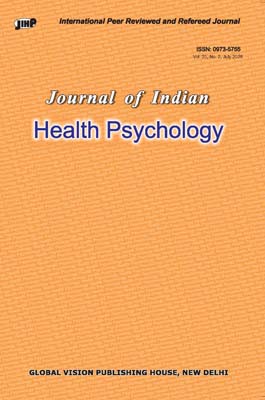
Description
Editorial
The 20th Volume, Issue 2 of the Journal of Indian Health Psychology brings together diverse and multidisciplinary research contributions that provide several new findings related to the field of health psychology and its allied aspects. By bridging insights from clinical practice, developmental studies, health related psychological problems and social frameworks, the article in this issue reflect the multifaceted nature of human well-being. Together, these diverse contributions underscore the evolving role of health psychology in navigating real-world challenges and informing evidence based approaches for holistic development.
In the first article Varisha and Shyodan Singh investigated about the self-esteem, social anxiety, self-acceptance and coping strategies in young adults raised by single mothers. The findings of the study revealed that men had scored significantly higher than women in self-esteem, self-acceptance whereas women scored higher in social anxiety. Also, younger subjects who lost their father in childhood had low self-esteem and self-acceptance compared to those losing their fathers in adolescence.
In the second article by Dhwani Mathure and Grace Lalkhawngihi conducted a comprehensive review about locus of control in the age of social media. Through this review it was found that individuals with an external locus of control might use the online community for further self-validation, which could lead to emotional distress and further lead to the addictive use of the internet. Further, the development of a sense of internal control could prove to be beneficial in allowing individuals to thoughtfully engage in digital platforms, thereby avoiding the need for external control.
In the next article Garima Gupta, Ved Prakash Rawat, Rajesh Kumar Mourya, Shatabdi Bhowmick, & Tanya Kumari explored the gender differences in Superstition, Optimism and Pessimism. The finding of the study revealed that there is significant gender differences in superstition and pessimism, where females scored higher in both superstition and pessimism in comparison to male participants. Interestingly, despite having high pessimism, there wasn’t any significant differences in optimism. Highlighting that, even after having more superstitious beliefs and pessimistic thinking, females are still able to think optimistically about their future and life outcomes as much as male participants do. The role of loneliness, social support, meaning in life and resilience in perceived health among older adults was studied by Somika Choudhary and Shyodan Singh. The findings revealed negative correlation of loneliness with meaning in life and perceived health. Additionally, a positive correlation was found between loneliness and resilience highlighting that older adults who have experienced a prolonged period of loneliness develop better internal coping resources to fight with adversities.
In the next article, Aaira Mehrotra and Tanya Johri studied the educator’s perspectives on VIA character strengths in Children with Autism Spectrum Disorder. The findings revealed that strengths related to emotional positivity and social engagement, such as humor, spirituality, and creativity, emerged as the highest-rated domains. Educators described that they saw a shift in perceiving and interpreting autistic behavior towards more strength oriented rather than of deficit-orientation.
Mandeep Sharma and Ajay Kumar studied the comparison between male and female school students on several dimensions of mental health, emotional intelligence and academic achievement. The findings of the study revealed that there is gender difference on several components of all three variables, but neither male nor female students are superior to one another in these psychological concepts. Male students have scored better on emotional stability, adjustment and self-concept dimension of mental health, whereas in intelligence dimension female have scored significantly better. Interestingly, when comes to emotional intelligence female have scored better in both inter management and intra management component, whereas male students have performed better in intra awareness, highlighting that males are more aware about their own emotion, but female students are able to manage them more effectively.
In the following article by Varshika Singh and Shyodan Singh a qualitative exploration between negotiating feminist identity and self-concept among Young Indian women was done within their sociocultural context. Seven overarching themes emerged from the data: Identity Formation and Development; Constrained Feminist Expression; Family and Sociocultural Context; Religion–Feminism Tension; Feminism and Self-Concept; Media, Discourse and Feminist Awareness; and Marriage, Relationships and Future Self.In eighth article, Sristi Sarangi, Abhipsa Sarangi and Lucy Sonali Hembram studied about the age and gender differences in the mental well-being among school students in Odisha. The findings revealed that children have a significantly higher mental well-being in comparison to adolescents, whereas gender differences were found non-significant.
Radhika Agarwal and Shyodan Singh have studied the impact of explicit crime content in webseries on desensitization, empathy and antisocial tendencies. Results indicated that exposure to crime content is positive correlated with desensitization. Also, males reported higher exposure to crime content then females. Further, Exposure to crime content significantly predicted desensitization, highlighting the need to reduce the consumption and production of crime content as desensitization is also associated with increased antisocial tendencies.
Niharika Punia, Rishita Sharma, Vishnudyutya Kumar Punj, Abhinav Singh, Rita, Priya Deshwal studied life skills as a predictor of short term self-regulation among school going adolescents. The finding revealed a significant positive correlation between short term self-regulation and life skills. Also, Life skills significantly predicted 24.4% variance in short term self-regulation. Highlighting the need to integrate life skills training to enhance short-term self-regulatory capacity in school-going adolescents.
The journal provides a multidisciplinary platform for empirical research, comprehensive reviews, and intervention oriented articles, addressing psychological, health, social, and other contemporary issues across diverse contexts. The editors extend their sincere gratitude to all contributing authors for their valuable research and to the referees and editorial board members for their thoughtful feedback and guidance. Through the dissemination of rigorous and diverse scholarly work, the journal seeks to enhance understanding of issues affecting individuals and communities and to promote evidence-based approaches that contribute to healthier, more resilient, and thriving societies.
Editors
| Editorial | (iii) | |
| 1 | A Quantitative Investigation of Self-Esteem, Social Anxiety, Self-Acceptance, and Coping Strategies in Young Adults Raised by Single Mothers | 1 |
| Varisha and Shyodan Singh | ||
| 2 | Locus of Control in the Age of Social Media: A Comprehensive Review | 13 |
| Dhwani Mathur and Grace Lalkhawngaihi | ||
| 3 | Superstition, Optimism, and Pessimism: Exploring Gender Differences | 23 |
| Garima Gupta, Ved Prakash Rawat, Rajesh Kumar Mourya, | ||
| Shatabdi Bhowmick, and Tanya Kumari | ||
| 4 | Perceived Health among Older Adults: The Role of Loneliness, Social Support, Meaning in Life and Resilience | 35 |
| Somika Choudhary and Shyodan Singh | ||
| 5 | Understanding Strengths Beyond Symptoms: Educators’ Perspectives on VIA Character Strengths in Children with Autism Spectrum Disorder | 46 |
| Aaira Mehrotra and Tanya Johri | ||
| 6 | A Comparative study on Emotional Intelligence, Academic Achievement and Mental Health among Male & Female School Students | 65 |
| Mandeep Sharma and Ajay Kumar | ||
| 7 | Negotiating Feminist Identity and Self-Concept among Young Indian Women: A Qualitative Exploration within Sociocultural Contexts | 77 |
| Varshika Singh and Shyodan Singh | ||
| 8 | Mental Well-Being Among School Students in Odisha: Insights Across Age and Gender | 91 |
| Sristi Sarangi, Abhipsa Sarangi and Lucy Sonali Hembram | ||
| 9 | Screens and Sensibilities: Impact of Explicit Crime Content in Webseries on Desensitization, Empathy and Antisocial Tendencies | 100 |
| Radhika Agarwal and Shyodan Singh | ||
| 10 | Life Skills as a Predictor of Short-Term Self-Regulation among School-going Adolescents | 112 |
| Niharika Punia, Rishita Sharma, Vishnudyutya Kumar Punj, Abhinav Singh, Rita, Priya Deshwal |






Reviews
There are no reviews yet.