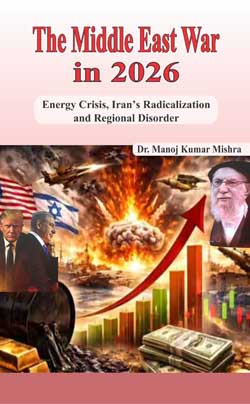
Description
About the Book
This book introduces three current interwoven crises at the root of the Middle East’s geopolitical volatility: These are -Energy Instability caused due to war in the Persian Gulf—particularly around the vital Strait of Hormuz—that has shattered the predictability of global oil and gas supply chains. This crisis is defined by a deep loss of faith in secure sea lanes, causing nations globally to stockpile resources and redesign energy grids; the second major crisis is Iran’s Radicalization and Resistance, which becomes visible in the decades of sanctions, isolation, and broken nuclear accords (such as the collapse of the JCPOA) breeding an intense survivalist mentality in Tehran. This has pushed Iran toward hardline resistance leading to arms exports and heavy arming of regional proxies defying unilateral military actions of the US and Israel. The third reason for the geopolitical instability is Diplomatic Paralysis. The conflict has fractured the post-Cold War order. Traditional western powers are navigating this landscape in relative isolation, while nations like China and Russia see the conflict from their own strategic, economic and diplomatic advantages.
It describes a cascading breakdown in global stability, driven by the following factors first,Energy Vulnerability as the Persian Gulf’s role in powering the global economy is shattered with military escalation turning the Strait of Hormuz into a strategic chokepoint; second,Iran’s Radicalization as decades of sanctions and isolation and breakdown of the JCPOA nuclear agreement convincing it that compliance is fatal. Survival is now equated with defiance, resulting in enriched uranium stockpiles, armed regional proxies and military support for allies and third Diplomatic Paralysis: The international system is fundamentally broken. The US operates largely in isolation, European allies are stepping back due to escalation risks and other global powers are maneuvering to exploit the conflict for economic and strategic gains.
About the Author
Dr. Manoj Kumar Mishra did his PhD from the Department of Political Science, University of Hyderabad, India. He is working as a Senior Lecturer (UGC,Net qualified in 2005) .at the Department of Political Science, Swami Vivekananda Memorial (Autonomous) College, Odisha. He has many published articles and commentaries in Journals and Magazines of International standard.For his persistent research work, the author has been awarded with Sarvapalli Radhakrishnan Gold Medal Award by Global Economic Progress and Research Association, New Delhi in 2021 and EET CRS, Research and Development Award in 2024as Best Researcher.Dr Mishra is the writer of three books such as Afghanistan and Major Powers: The Interface of Geostrategic, Geopolitical and Geo-economic Factors and Identity, and State and Globalization.







Reviews
There are no reviews yet.